

WORKS
Osaka University, Yamaguchi Lab: We constructed a 3-sided immersive theater and produced immersive video content for introducing their research project.
Kadince Inc. (Headquarters: Shibuya-ku, Tokyo; Representative Director: Takayuki Aoki) constructed a three-sided immersive theater in the research building and planned and produced immersive video content for project introduction to be projected in the theater, in connection with the "Next-Generation Communication Project Using Low Earth Orbit Satellites" promoted by Osaka University's Yamaguchi Laboratory.
Video Content
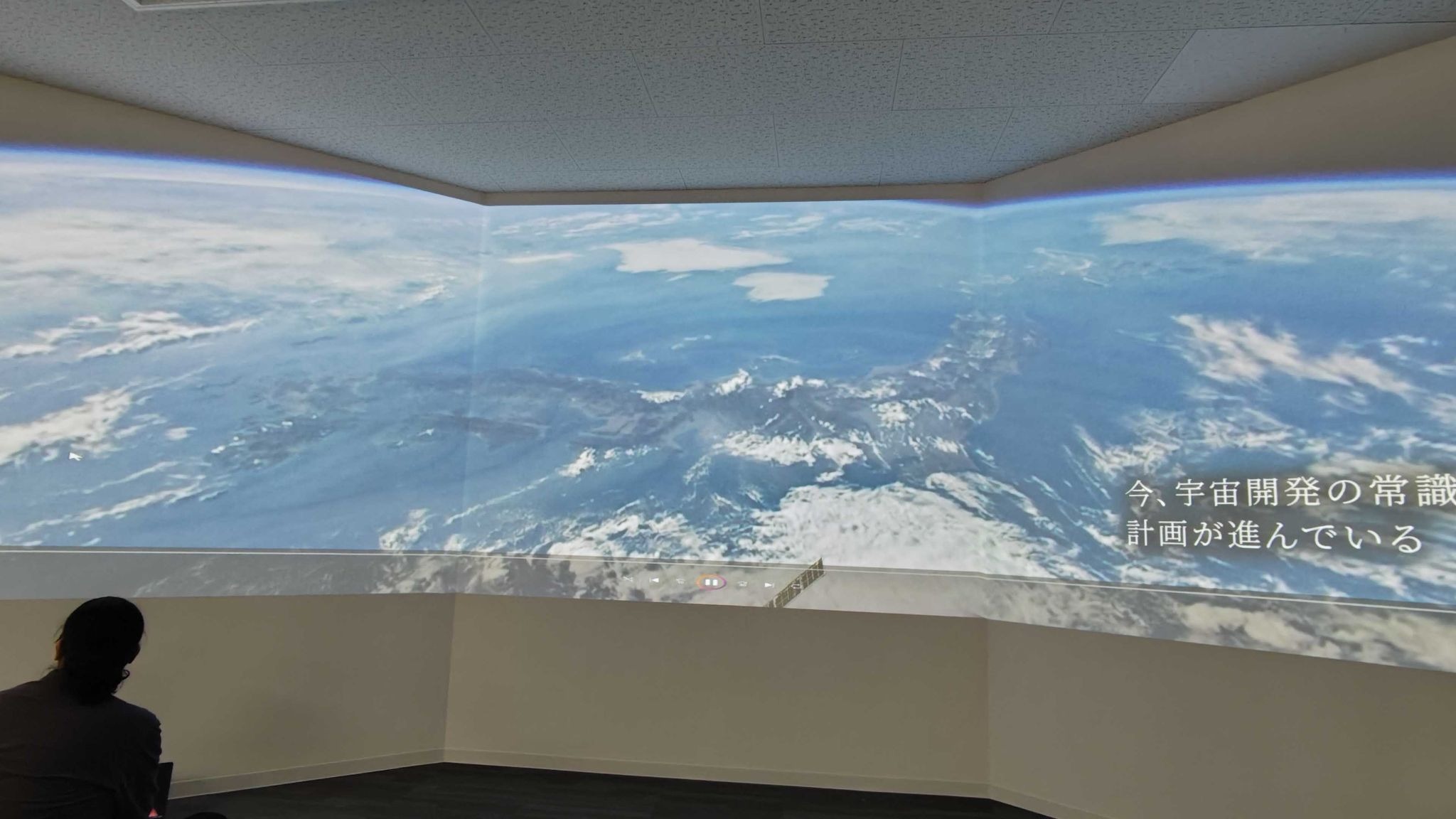
This video was produced to introduce Osaka University's Yamaguchi Laboratory's research project—large-scale satellite formation flight technology in Low Earth Orbit (LEO) and the possibilities it opens for next-generation non-terrestrial networks (NTN). It consists of a series of scenes, starting with an explanation of "formation flight," where microsatellites collaborate like an orchestra, followed by the mechanism of integrated simulation that precisely reproduces the behavior of a constellation of 100,000 satellites, and finally, the social impact brought about by direct-to-device (D2D) communication between satellites and ground terminals. We created an immersive video that maximizes the immersive experience of the three-sided screen, depicting a future where new communication infrastructure built in space supports connectivity in mountainous areas, remote islands, and disaster sites.
Video Production Process
Scenario Creation: Translating Academic Documents into "Video Language"
The starting point for production was a lecture manuscript (for experts) provided by the Yamaguchi Laboratory from an academic conference. In the process of transforming specialized content into a video scenario, we quickly created a "draft" reconfigured as a story flow understandable to a general audience, with the help of generative AI. Subsequently, we repeatedly refined the scenario based on feedback from researchers and created the final storyboard. In the process of converting the content into a narrative that ensures academic accuracy while creating visual immersion, generative AI acted as a "translator," allowing us to concentrate resources on creative decisions.
Video Material Generation: A Hybrid Workflow Combining Multiple AI Tools
Generative AI tools such as Gemini, Vidu, and Kling AI were used for generating video materials. AI tools were particularly useful for scenes that are difficult to film in live-action, such as outer space, satellite constellations, communication scenes in mountainous areas, and futuristic cityscapes with autonomous driving.
To obtain generated results that align with the creators' intentions, we adopted an approach of generating numerous short clips, approximately 3-5 seconds each, and then assembling them through editing. This method ensured more stable quality than attempting to generate longer footage in one go, allowing us to select materials closely matching the desired composition and camera work from multiple options. We established a hybrid workflow, utilizing different tools according to the requirements of each scene, such as removing unwanted elements from generated materials or animating still images.
High-Resolution Support: Tackling 8000 Pixels with AI Upscaling
The total projection resolution for the three-sided theater extends to approximately 8,000 pixels horizontally (8K). Since current generative AI video tools cannot directly output materials meeting this resolution requirement, we introduced an AI upscaler to enhance the resolution of the generated content. By combining video production using generative AI with high-resolution enhancement via upscaling tools, we were able to ensure video quality suitable for viewing on a large screen.
Editing Process: Color Tone Unification and Optimization for Three-Screen Layout
Materials originating from multiple generative AI tools each had differences in color tone, brightness, and camera work. To ensure visual consistency, during the editing phase, we applied adjustment layers across the entire project to unify the color palette and carefully arranged materials to avoid unnatural directions or color temperatures when adjacent.
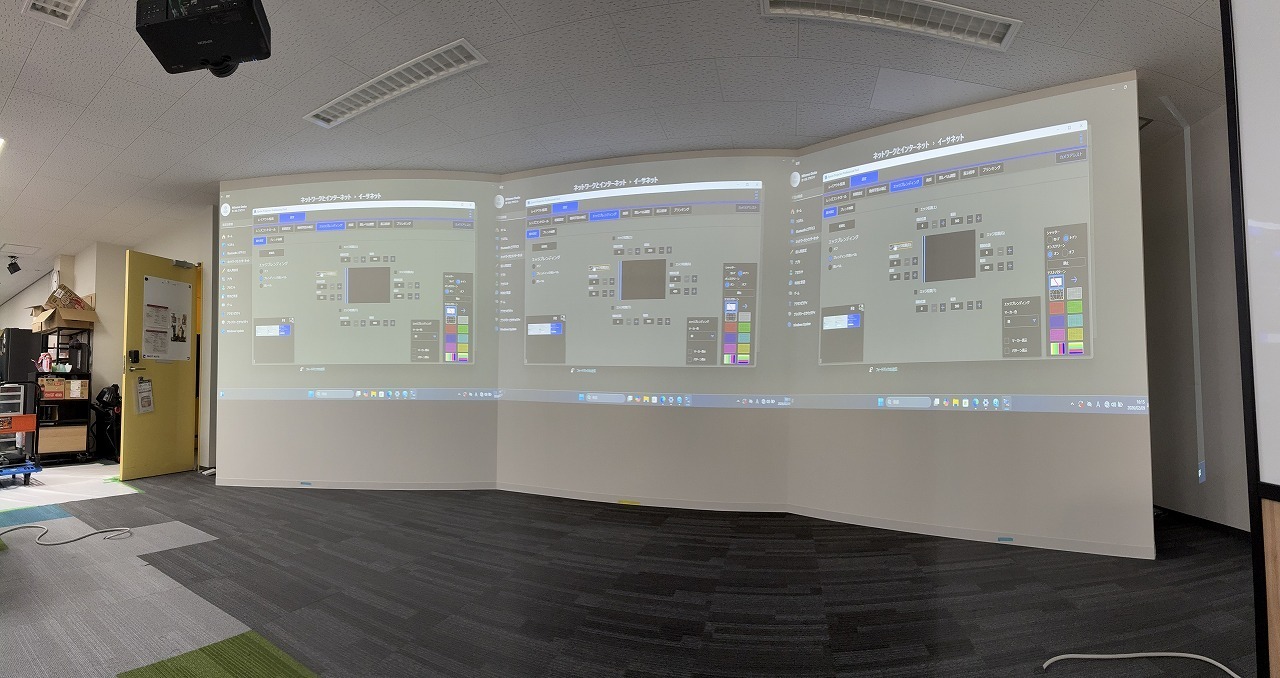
The visual design unique to a three-sided theater was also a critical challenge. Due to the structure where the left and right screens are angled, placing text at the far left or right edges of the screen significantly impairs readability. Furthermore, as the physical boundaries between screens are easily visible, we adopted a policy of positioning text and key information inward, centered on the middle screen. Additionally, we first recreated the theater in a virtual space using 3D simulation software to gain an understanding of how it would appear in the projection environment. Following this, we visited the theater under construction at Osaka University's Suita Campus to project various text sizes and layout patterns, confirm their effectiveness, and finalize the visual design.
AI Narration Generation: Flexible Adaptation to Academic Accuracy
All narration was generated using AI text-to-speech (TTS). In video production for academic fields, it is crucial to ensure the accuracy of content, including the pronunciation of technical terms and the notation in on-screen text. By adopting AI narration generation, we were able to incorporate client review feedback right up until delivery, thereby enhancing academic accuracy. Achieving stable pronunciation (intonation) and consistent voice quality was not a one-time output; it required a process of trial and error to select the optimal results.
Design and Construction of the Three-Sided Immersive Theater
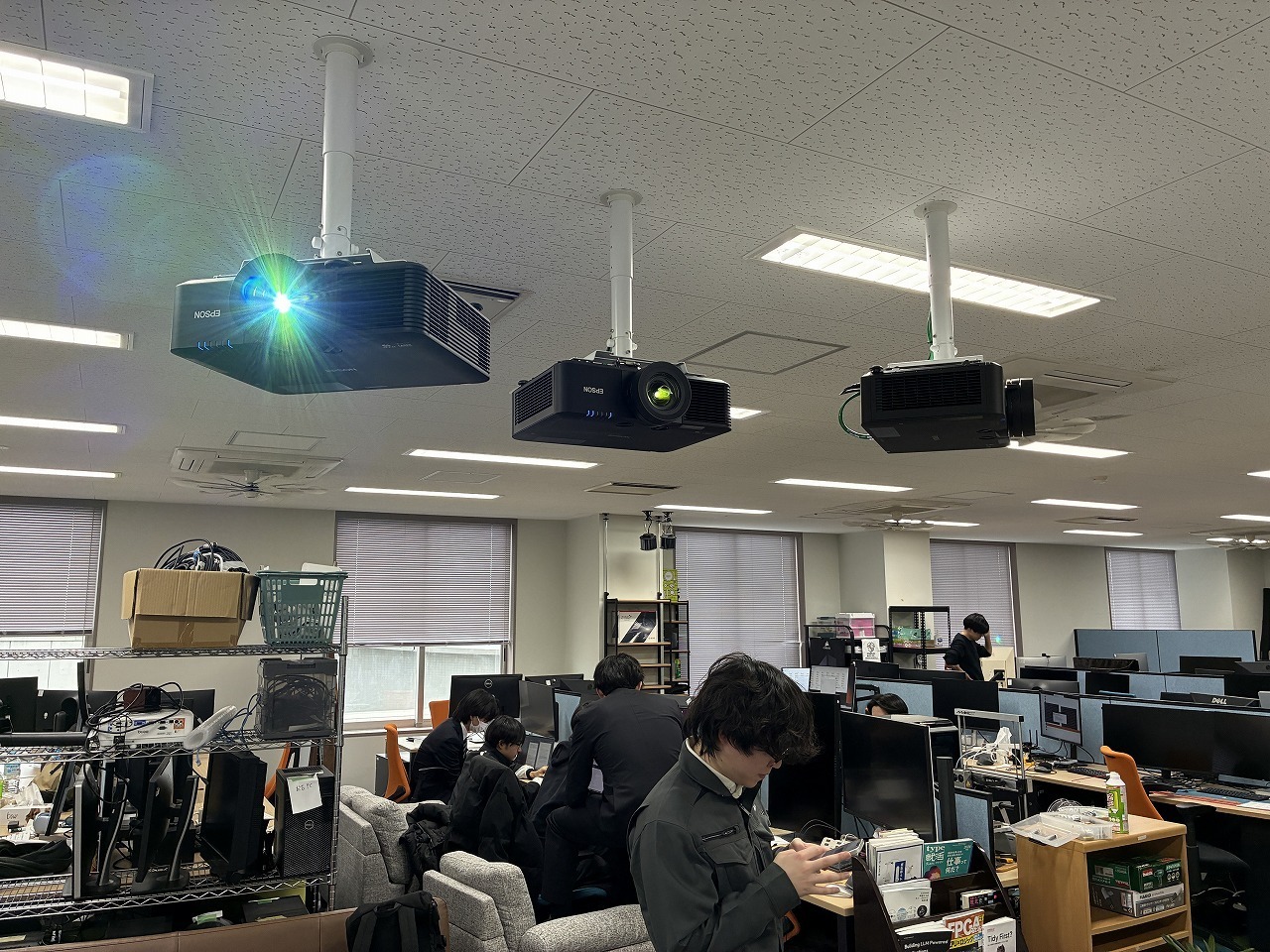
The three-sided immersive theater, where this video is projected, is installed at Osaka University's Suita Campus and features three Epson 4K projectors (EB-L795SE) ceiling-mounted to project onto three screens (each W2,400×H2,700mm). Video signals are transmitted to each projector via HDMI transmitters (VE801T), allowing for flexible video switching using a matrix switcher (VM6404HB). The design and construction of this theater were carried out with the cooperation of Sanyu Co., Ltd.
About Our Immersive Content Development
At Kadince, we offer end-to-end content development services leveraging XR and AI technologies. This includes everything from planning and producing immersive video content for academic research institutions and industrial sectors (like the project mentioned) to designing and constructing immersive video spaces, such as 3-sided theaters. We can propose solutions tailored to your specific needs, whether it's establishing workflows for accurate visualization of research papers and specialized materials, or creating immersive content specifically for large-screen projection. Please feel free to contact us.


RELATED PROJECT
